

How we review it
Your documents come first
Here is what we look at, in order.
- 01
Eligibility review
Map work history, language, education, status in Canada and family information to current federal and provincial criteria.
- 02
Document plan
Identify language tests, credential assessments, reference letters, civil records and financial evidence needed before profile creation or application.
- 03
Selection strategy
We compare Express Entry score factors and category-based selection with provincial streams that are currently available.
Calculate your CRS score → - 04
Invitation and application
After an invitation or nomination, submit a complete application by the stated deadline and keep the information accurate.
In plain terms
How do skilled workers immigrate to Canada?
Skilled worker immigration is a group of federal and provincial routes, not one application. Express Entry manages the Canadian Experience Class, Federal Skilled Worker Program and Federal Skilled Trades Program. Provinces and territories also nominate people for local labour and demographic needs. You must first qualify for a program; a score or provincial interest comes afterward.
We map the person’s work, language, education, location and status to the current rules. Then we compare selection chances and document demands. A pathway can be open while a particular stream is invitation-only, capped or temporarily closed, so the program page and the province’s notice must be checked on the day of action.
Who is this for?
You have eligible foreign work and want to test Federal Skilled Worker eligibility. You completed Canadian study and now have authorized skilled work that may fit the Canadian Experience Class. Your occupation, language or provincial connection may fit a targeted nomination stream.
A person seeking a temporary job authorization should begin with the work-permit strategy page. If you already know that Express Entry applies, use the detailed Express Entry page and CRS calculator.
What does an immigration officer check?
The officer checks whether you meet the legal requirements and whether the records support the application you submitted.
Which immigration program do you qualify for?
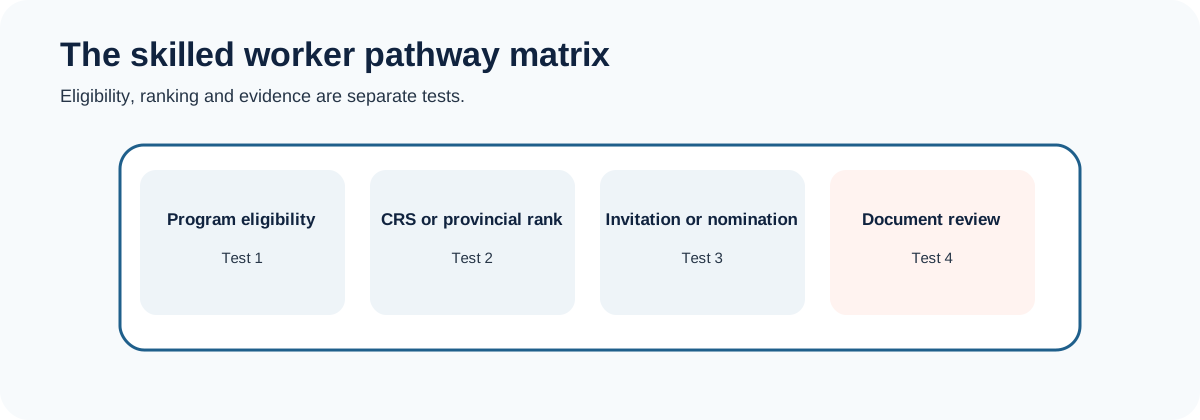
The facts must meet one federal or provincial program before ranking matters.
CEC, FSW and FST count work, language, education, job offers and settlement funds differently. A provincial nomination also requires the province to nominate you under one of its current streams.
Does the work fit the claimed NOC?
The duties, dates, hours, pay and status must support the occupation and program requirement.
A job title alone proves little. Officers compare the lead statement and main duties with employer records and may look at payroll, tax and corporate evidence.
Are language and education records valid?
Approved language results and an educational credential assessment must be current when the program requires them.
The required level depends on the program and occupation. An ECA confirms immigration equivalency; it does not replace the credential or guarantee points.
Does the score match the documents?
IRCC recalculates points from the records after invitation.
Age, family, education, language, work, nomination and other factors must match the profile. A provincial nomination through Express Entry adds 600 CRS points, but only after the nomination is accepted.
Will the applicant settle where the program requires?
Provincial nominees must intend to live in the nominating province, and federal applicants must meet any location rule.
Connections, job search, family, study and plans may be examined. Quebec and Nunavut do not use the federal PNP structure described on IRCC’s page.
What evidence makes the application easier to assess?
Good evidence answers a specific concern and agrees with the forms, dates and amounts elsewhere in the file.
Work experience
What it needs to prove: Occupation, duration, hours, pay and authorized status.
What leaves questions: A reference letter that lists only title and employment dates.
What answers them: Detailed employer letters supported by contracts, payroll, tax and business records where available.
Language and education
What it needs to prove: The program threshold and points actually claimed.
What leaves questions: An expired test screenshot or degree without an ECA when one is required.
What answers them: Official results, credential, transcripts and a valid ECA tied to the profile entries.
Settlement funds and family size
What it needs to prove: That accessible money meets the applicable program amount.
What leaves questions: A borrowed deposit immediately before filing.
What answers them: Six-month account history, source records, liabilities and the correct family-size calculation.
Provincial connection
What it needs to prove: Why the applicant qualifies for and intends to settle under the stream.
What leaves questions: A generic statement that any province is acceptable.
What answers them: Nomination records plus work, study, family, licensing or settlement evidence specific to the province.
A composite example
An engineer has six years of foreign experience but the employer letter uses only the title “project manager.” The CRS estimate includes the work, and a provincial profile uses an engineering NOC. The duties cannot be verified from the letter.
The applicant obtains a new reference describing projects, reporting lines, hours and pay, supported by contracts and payroll records. The duties point to a different NOC than the title suggested. The profile and provincial strategy are updated before an invitation. A lower but supportable score is safer than points that disappear when IRCC checks the documents.
What will it cost?
For Express Entry federal high-skilled and PNP permanent residence, IRCC lists CAD $1,590 for each adult, including the CAD $600 right of permanent residence fee, and CAD $270 for a dependent child. Provincial application fees differ. Tests, an ECA, translations, police certificates, medicals and biometrics are separate.
We quote program comparison, profile review or representation after checking the work history and family. See our fees and cost guide.
How long can it take?
There is no guaranteed time to receive an invitation or provincial nomination. After filing, IRCC publishes an estimate by program. You control valid documents, accurate updates and response time; governments control draws, nominations, screening and inventory.
Use the IRCC processing-time tool ↗ and compare only relevant rounds on the Express Entry draws page.

Why can a skilled worker application be refused?
A refusal often starts with a question the records did not answer. A new application should address that reason with changed evidence, not simply send the same file again.
The applicant does not meet the selected program
How to address it: Test each eligibility rule separately before relying on the CRS or provincial score.
The employer evidence does not support the NOC
How to address it: Document duties, dates, hours and pay with records the employer can verify.
The score falls below the invitation cut-off
How to address it: Recalculate from current documents before accepting an invitation and remove unsupported points.
A language test, ECA or passport expired
How to address it: Track expiry dates and renew early enough to remain valid at the required stage.
Settlement funds are borrowed or unavailable
How to address it: Show account history, source and access using the program’s current family-size amount.
The provincial intention is not credible
How to address it: Use evidence specific to the nominating province and explain connections elsewhere.
What changed recently?
Rules and intake conditions can change. The application must use the requirements that apply on the day it is submitted.
IRCC removed CRS points for arranged employment
Job offers no longer add 50 or 200 CRS points, though an offer can still matter to eligibility in some programs.
Read the IRCC source ↗Federal high-skilled fees increased
The adult processing fee became CAD $990 and the right of permanent residence fee CAD $600.
Read the IRCC source ↗
What can you do yourself, and what can we do?
You can prepare and submit your own application. Professional help is useful when you want someone to test the evidence against the rules, identify gaps and put the scope in writing.
Do it yourself
You can compare programs, take a language test, obtain an ECA, request employment records and create profiles yourself. Keep a worksheet connecting every eligibility fact and point to one document. Update changes before they become contradictions.
Use the CRS calculator as an estimate, then verify the program and documents independently.
Work with our office
We assess federal and provincial eligibility, NOC selection, score, expiry dates and the evidence plan. Under a retainer, we review profiles, prepare applications and manage government requests.
We do not sell access to a nomination, predict a draw or present an expression of interest as an invitation.
Where our work stops: We cannot guarantee a draw, provincial invitation or nomination, and we will not claim points that the available records do not support.
Skilled worker immigration questions
Is Express Entry the only skilled worker route?
No. Provinces and territories operate nomination streams, and other federal or regional programs may apply. Each has separate criteria and intake conditions.
Does a provincial nomination guarantee permanent residence?
No. The applicant must maintain nomination and program requirements and pass the federal admissibility and application review.
How many CRS points does an Express Entry nomination add?
An accepted Express Entry-linked nomination adds 600 CRS points. It does not replace federal program eligibility.
Can I use my job title to choose a NOC?
The duties matter more than the title. Compare the actual work with the NOC lead statement and main duties, then support it with employer records.
Do I need proof of funds?
It depends on the program and circumstances. Calculate the current family-size amount and document the source and availability when required.
Can you guarantee a provincial invitation?
No. Provinces choose candidates under changing rules and allocations. We can identify a fit and prepare a supportable record.
Official sources
The pages we checked when we last reviewed this program.