

How we review it
Your documents come first
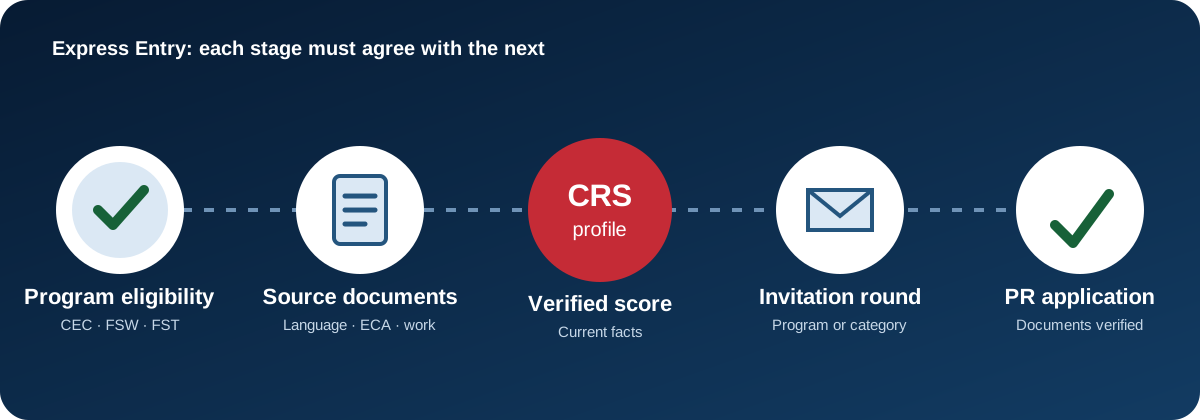
Here is what we look at, in order.
- 01
Confirm program eligibility
Test the facts against the Canadian Experience Class, Federal Skilled Worker Program and Federal Skilled Trades Program separately.
- 02
Calculate and verify the CRS score
Use exact age, education, language results, work experience, spouse factors and applicable additional points.
- 03
Create and maintain the profile
Enter evidence-backed information and update the profile when scores, documents or family circumstances change.
- 04
Respond to an invitation
Submit a complete permanent-residence application within the stated deadline and resolve inconsistencies before filing.
In plain terms
How does Express Entry work?
Express Entry is the system IRCC uses to manage the Canadian Experience Class, Federal Skilled Worker Program and Federal Skilled Trades Program. You must qualify for at least one. IRCC then places an eligible profile in the pool and gives it a Comprehensive Ranking System score.
IRCC holds general, program-specific or category-based rounds. Candidates compete within the round that applies to them, so a healthcare cut-off cannot predict a Canadian Experience Class round. Pool entry does not guarantee an invitation. After an invitation, IRCC verifies the program, points, category requirements and admissibility.
Who is this for?
This page is for a skilled worker who may qualify through Canadian or foreign experience, a trade, or an Express Entry-linked provincial nomination. It also helps pool candidates verify a score, occupation code or document.
A category can lead to consideration in a targeted round, but it does not add fixed CRS points. IRCC’s 2026 list covers French, healthcare and social services, STEM, trades, education, transport, several Canadian-experience groups and skilled military recruits. Each has separate instructions.
Use our skilled worker overview to compare programs, the CRS calculator to estimate points, and the draws page to compare relevant rounds.
What does an immigration officer check?
The officer checks whether you meet the legal requirements and whether the records support the application you submitted.
Do you qualify for one of the three managed programs?
The principal applicant must meet the Canadian Experience Class, Federal Skilled Worker Program or Federal Skilled Trades Program.
Each program tests work, language, education and job offers differently. Federal Skilled Worker applicants also face a separate selection-factor threshold. A high CRS estimate cannot repair program ineligibility.
Are the language and education points valid?
Use approved language results and an immigration-purpose ECA for foreign education where required.
Language results must be under two years old at profile and application. An ECA must be under five years old at both stages. Enter the result from the report, not a résumé or transcript.
Does the work history match the claimed NOC?
The NOC must reflect the work performed, including the lead statement and enough main duties.
A title alone is insufficient. Dates, hours, pay and status should agree with contracts, payroll or tax records. Category work must also meet the round instructions.
Is every CRS point supported?
IRCC recalculates the score after invitation and can refuse if it falls below the round cut-off.
Age, family, education, language, work and additional factors can change the total. Job offers stopped receiving 50 or 200 points on 25 March 2025, though an offer can still affect program eligibility.
Are settlement funds required and available?
FSW and FST applicants generally need the current family-size amount; CEC applicants do not.
IRCC requires bank letters and updates the minimums. Borrowed money and property equity do not count. Family size includes a spouse or partner and dependent children, even if they are not accompanying you.
Did the profile stay accurate?
Update material changes and support the information used for the invitation.
Tests, birthdays, family, work, nominations and status can affect the profile. After invitation, IRCC also checks police, medical and personal-history records. An omission can raise misrepresentation concerns.
What evidence makes the application easier to assess?
Good evidence answers a specific concern and agrees with the forms, dates and amounts elsewhere in the file.
Work experience and occupation code
What it needs to prove: The duties, dates, hours, pay and status required by the program or category.
What leaves questions: A letter with only a title and start date.
What answers them: Detailed employer letters supported by contracts, pay or tax records where available.
Language and education
What it needs to prove: The results used for eligibility and CRS points.
What leaves questions: A credential or screenshot without an accepted test or ECA.
What answers them: Valid reports whose names and dates match the profile.
Status, family and profile changes
What it needs to prove: That the score and family record stayed accurate.
What leaves questions: No update after marriage, a new test or work change.
What answers them: A change log, supporting records and a fresh calculation before accepting the invitation.
Funds, nomination and category evidence
What it needs to prove: The extra requirement or selection basis.
What leaves questions: A balance, nomination email or title without source records.
What answers them: Required bank records, an accepted nomination and work evidence that meets the category instructions.
A composite example
A software analyst has eleven months of authorized Canadian skilled work, earlier foreign experience and an accompanying spouse. His calculator result includes a full Canadian year and 50 job-offer points. Neither claim works: the year is incomplete, and job-offer points ended in March 2025.
He waits for the full year, obtains a duties-and-hours letter, enters his spouse’s test and recalculates. The lower score is supportable. A matching category could place him in a targeted round, but it cannot replace CEC eligibility or guarantee an invitation.
What will it cost?
IRCC lists CAD $1,590 for each adult, including the CAD $990 processing fee and CAD $600 right of permanent residence fee. A dependent child costs CAD $270. Biometrics are CAD $85 per person or up to CAD $170 for an eligible family. We checked these charges on 8 September 2026.
Tests, an ECA, medicals, police certificates, translations and provincial fees are separate.
A 30-minute consultation is CAD $100.00 total; no HST. We quote other work in writing after reviewing the program, family and records.
How long can it take?
You have 60 days to finish a new profile. A submitted profile expires after 12 months without an invitation. An invitation gives you 60 days to file the permanent-residence application.
IRCC’s estimate starts after it receives the complete application, not at pool entry. Verification, medical or security checks and document requests can add time. Check the IRCC processing-time tool ↗.

Why can an Express Entry application be refused?
A refusal often starts with a question the records did not answer. A new application should address that reason with changed evidence, not simply send the same file again.
The principal applicant does not meet the selected program
How to address it: Recheck the program requirements independently from the CRS total and document the qualifying work period.
The verified CRS score falls below the round cut-off
How to address it: Recalculate from the records in force on the invitation date and remove any point that cannot be supported.
The work evidence does not support the NOC or category
How to address it: Use letters and supporting records that describe duties, hours, pay and dates instead of relying on the job title.
A language test or ECA expired
How to address it: Check validity before entering the pool and again before filing; obtain a new result when the document will not remain valid.
Family, status or personal history is inconsistent
How to address it: Build one chronology, report material changes and reconcile the profile, forms and civil or immigration records.
Funds or admissibility evidence leaves a gap
How to address it: Provide the required bank record and source history, police certificates, medical results and any explanation the facts require.
What changed recently?
Rules and intake conditions can change. The application must use the requirements that apply on the day it is submitted.
IRCC announced the 2026 categories
IRCC renewed French, healthcare and social services, education, STEM and trade categories. It added or identified transport, physicians, senior managers and researchers with Canadian work experience, and skilled military recruits. Current category instructions control eligibility.
Read the IRCC source ↗Permanent-residence fees increased
The economic-immigration processing fee became CAD $990, the right of permanent residence fee became CAD $600 and the dependent-child fee became CAD $270.
Read the IRCC source ↗IRCC removed CRS points for job offers
Current and future pool candidates no longer receive 50 or 200 CRS points for an arranged job offer. An offer can still matter under a program’s eligibility rules.
Read the IRCC source ↗
What can you do yourself, and what can we do?
You can prepare and submit your own application. Professional help is useful when you want someone to test the evidence against the rules, identify gaps and put the scope in writing.
Do it yourself
You can check the programs on IRCC’s site, take a test, obtain an ECA and build your profile. Keep a worksheet linking every eligibility fact and point to a record. Save submissions, messages and uploaded files.
Update material changes. Before accepting an invitation, recalculate using the documents available that day and confirm the round applies to you.
Work with our office
Our office can assess program eligibility, NOC and employment records, language and education entries, the CRS calculation and the profile. After invitation, we can compare the application with the invited profile and address inconsistencies under a written scope.
A consultation is advice. Profile review or representation needs a separate written agreement. We do not predict a future score or present a category or provincial expression of interest as a promised invitation.
Where our work stops: We do not predict invitation scores, alter job duties to fit an occupation code, create work experience or funds, or promise an invitation or permanent-residence decision.
Express Entry questions
Does entering the Express Entry pool guarantee an invitation?
No. IRCC ranks eligible profiles and invites candidates through general, program-specific or category-based rounds. The score and round instructions control who is invited.
Does a category give extra CRS points?
No fixed category bonus is added. IRCC identifies candidates who meet the category rules, ranks those candidates by CRS and invites the highest-ranked profiles in that round.
Do job offers still receive 50 or 200 CRS points?
No. IRCC removed those points on 25 March 2025. A qualifying job offer can still matter to eligibility under the Federal Skilled Worker or Federal Skilled Trades rules.
How many points does an Express Entry provincial nomination add?
An accepted and verified Express Entry nomination adds 600 points. The candidate still needs to remain eligible and receive an invitation before applying for permanent residence.
How long are language tests and ECAs valid?
Approved language results must be less than two years old. An immigration-purpose ECA must be less than five years old. Both must be valid when the profile is completed and when the application is submitted.
How long do I have after an invitation?
IRCC gives 60 days to submit the complete permanent-residence application. If you do not decline or apply within that period, the invitation expires and the profile is removed from the pool.
Should I update my profile after marriage or a new test result?
Yes. Family composition, language, education, work, nomination and status changes can affect eligibility or points. Recalculate before relying on an invitation.
Official sources
The pages we checked when we last reviewed this program.